A restaurant or bar website: what guests check first
What a guest checks on their phone before choosing a bar, café or restaurant, the mistakes that send them elsewhere, and how one lounge bar site answers all of it in a single scroll.

 Websites · Bars, cafés and restaurants
On this page
A restaurant or bar website has to answer five questions on a phone: what is on the menu and what it costs, what the place looks like, whether it is open tonight, where it is and how to book or call. Put the menu on the page as text with prices, not as a PDF or a photo of the printed card. On the Velvet Panda Lounge site all five fit into one scroll, and the hours show whether the lounge is open right now. A site like this starts from $250 and takes from 1 week.
In numbers- A website for a bar, café or restaurant starts from $250 and takes from 1 week; the price is fixed in a written scope before work starts.
- The Velvet Panda Lounge menu is 4 cards with prices, on the page itself rather than in a PDF.
- Everything a guest checks fits into one scroll: the mood, the prices, the hours and the way there. The site went live in July 2026.
- The lounge’s hours show whether it is open right now, including the Friday and Saturday nights that run past midnight.
- 25% of diners always check a restaurant’s menu before deciding where to eat and another 34% often do, according to Toast’s 2024 survey of 850 U.S. adults.
What does a guest check before coming?
Five things: the menu with prices, what the place looks like inside, whether it is open tonight, where it is and how to book or call. Guests check them on a phone, and when one answer is missing, the next place in the search results is a tap away.
The menu comes first for many of them. In a survey of 850 U.S. adults that Toast ran in September 2024, 25% said they always check a restaurant’s menu before deciding where to eat, and another 34% said they often do.
A restaurant website is the page a guest opens before choosing where to spend the evening: the menu with prices, real photos of the room, today’s hours, the address and a way to book, all readable on a phone. A bar or a café needs the same page; only the menu changes.
Below we go through those five answers on one real example, the site we built for Velvet Panda Lounge, a lounge bar whose site went live in July 2026. The rules for any small business site, such as prices, messengers next to the form and several languages, are in what a small business website needs in 2026. Here we keep to what a bar, café or restaurant needs on top of them.
Aren’t social media and a map listing enough?
They help guests find you, but they rarely give all five answers in one place. That was where the lounge started. Lounge bars often live on social media and map listings, where the menu is a photo of a printed card, the opening hours sit in an old post, and the atmosphere, the thing people actually come for, barely comes across.
Guests still pick where to spend the evening on their phone. A site of your own puts every answer on one page that you control, and you link to it from your profile and your listing. Social media keeps bringing people in, and the site is where they land when they want the details.
How should the menu look on the site?
As text on the page, with a price next to each item, not as a PDF or a photo of the printed card. A PDF opens somewhere else, its type is tiny on a phone, and the guest has to pinch and drag to read a single line.
Diners notice. In Popmenu’s April 2023 survey of 1,000 U.S. consumers about ordering food online, 49% said they would move on and order from a different restaurant if they hit a PDF menu on a phone, up from 30% two years earlier.
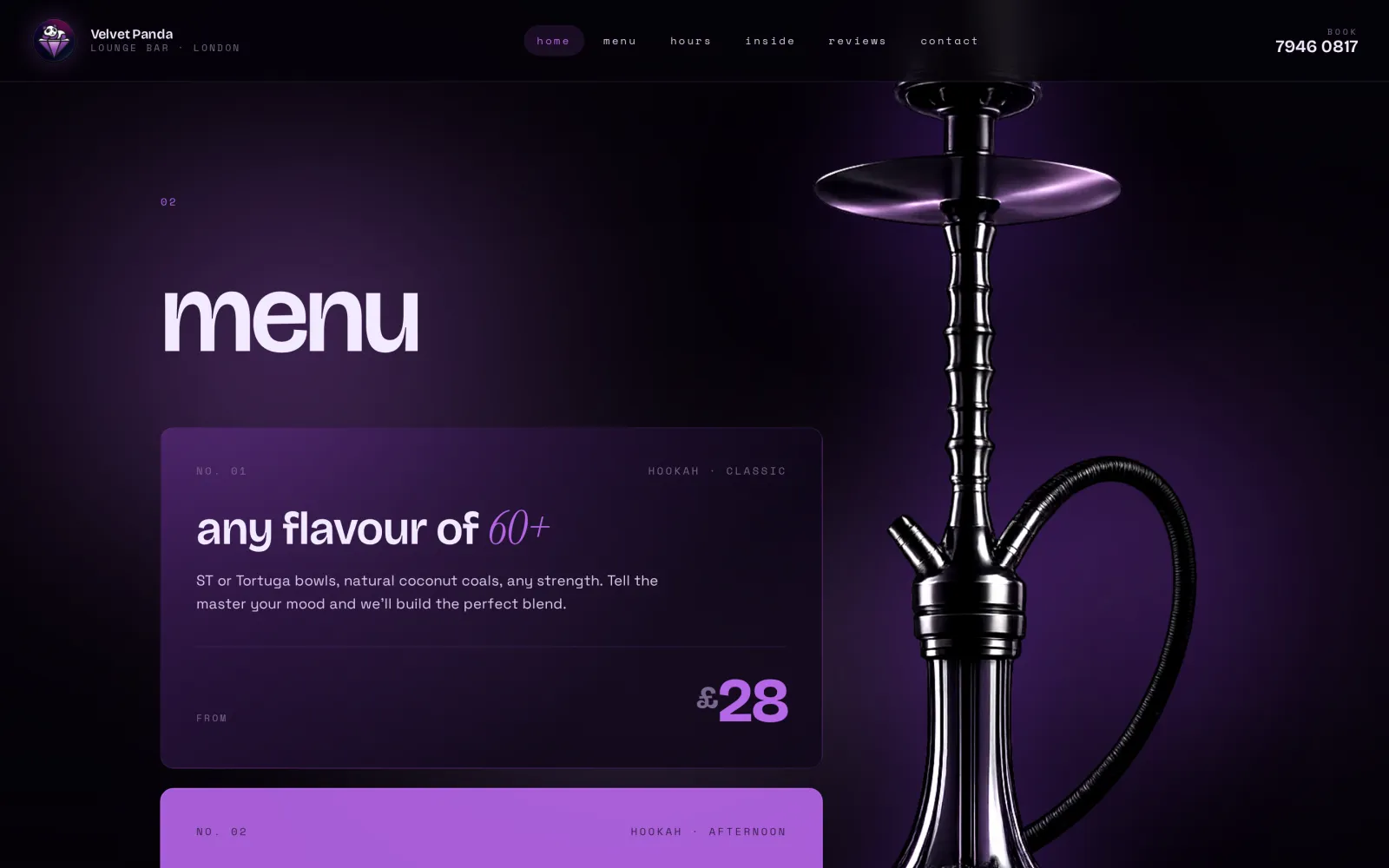
The Velvet Panda menu is four cards with prices. The cards are part of the page, so they scroll with everything else and read on a phone as easily as on a laptop. Because the prices are right there, a guest knows what the evening will cost before leaving home, and that is the change the owner noticed:
I asked for it to look expensive and was afraid of getting gold letters on a black background. Now people check the menu before they come, not at the table.
Owner of a lounge bar · Website
A long restaurant menu works the same way. Split it into sections a guest can jump between, and keep each price in the same place on every line, so the eye finds it without searching.
How do you show the mood of the place?
With real photos of your room and a design that feels like the evening you sell. Stock photos of smiling strangers tell a guest nothing about your place. Your own interior, light and tables tell them almost everything.
The owner of the lounge asked us to make it look expensive. The site is one long page that works like walking in: a full-height hookah stands beside the text, and as you scroll the “camera” pans down it, with three layers of slow smoke on top. Further down comes a gallery of the real interior, photos of the lounge itself, used with permission.
Movement like this has to stay light. Scrolling stays smooth on phones, and a guest who has turned animations off in their device settings gets a calm page without the smoke and the panning. The mood comes across either way.
Is the place open right now?
The site should tell the guest in one line, without making them work out the day and the time. A table of hours does half the job. The other half is a line that says “open now” or tells the guest when you open next.
On the lounge site the hours are live. Today’s row is highlighted, and a status line says whether the lounge is open right now or when it opens next, including the Friday and Saturday nights that run past midnight. Those late nights are where a plain table trips people up: at one in the morning it is already Saturday on the calendar, but the bar is still in its Friday night.
For the version in our portfolio we also made the status follow the venue’s own time zone instead of the visitor’s, so a guest whose phone is still on another clock sees the right answer. And nobody has to post “open late tonight”: the status works it out from the weekly hours.
Where is it, and how does a guest book?
Put a map, the contacts and a way to book on the same page as the menu, so a guest never has to copy an address into another app. The lounge site ends with a map and contacts, and a guest can call or get directions without leaving the page.
How a guest books depends on how you take bookings. If you take them by phone, make the number a link that starts the call. If you would rather have them in writing, a short form can send each request straight to your Telegram, or the button can lead to the booking service you already use. If your guests already write to you in Telegram, table requests can also go through a Telegram bot.
Which mistakes send guests somewhere else?
A PDF menu, missing prices, stale hours, a page that only works on a computer, stock photos and a hidden address: each one leaves a guest without one of the five answers. Here they are next to what the lounge site does instead:
| Mistake | What the guest gets | What the lounge site does |
|---|---|---|
| The menu is a PDF or a photo of the printed card | Tiny type, pinching and zooming on a phone | Four menu cards, part of the page itself |
| No prices | No idea what the evening will cost | A price on every card |
| Hours in an old post | A guess whether the place is open tonight | Live hours: today’s row highlighted and an “open now” status |
| Looks good only on a computer | A cramped, slow page on the phone in their hand | Smooth scrolling on phones and a calm version for guests who turn animations off |
| Stock photos, or none | No feel for the place | A gallery of the real interior |
| Address and phone hard to find | Copying the address into a map by hand | A map with contacts: call or get directions without leaving the page |
Each fix is small on its own. What matters is having all six at once, because one dead end is enough for a guest to choose another bar.
What should the site do for the owner?
Bring in guests who already know what to expect, and answer the routine questions so your staff don’t have to. A guest who has seen the room, the menu and the prices chose you knowing all three, and every answer on the page is one less “are you open tonight?” message during service.
It also has to look like your place. The lounge owner wanted it to look expensive without the clichés, and got a dark site where the hookah, the smoke and the real interior set the tone. A café would get a different page: the same five answers, in its own light.
And it should be easy to keep current. On the lounge site the “open now” status works itself out from the weekly hours. If you change the menu every season, ask for an admin panel so you can edit dishes and prices yourself.
How much does a restaurant website cost?
Our websites start from $250 and take from 1 week. The price moves with the number of pages and languages, an admin panel for editing the menu yourself, texts, photos and translation, and integrations such as a booking service.
The first call and the written scope are free. We name the price once the work is agreed and counted; it is fixed before work starts and changes only if the scope changes. You click through a working version before the bulk of the work, and the person who scopes your site builds it. We work remotely from Batumi, Georgia, in English or Russian, and how we scope a project walks through each step.
Questions
How much does a restaurant website cost?
A website starts from $250 and takes from 1 week. The exact price is fixed in a written scope after a free call, and it moves with the number of pages and languages, an admin panel for editing the menu, texts, photos and translation, and integrations such as a booking service.
What should a restaurant or bar website include?
The menu with prices, real photos of the room, today’s hours, a map with the address and a way to book or call, all readable on a phone. On the Velvet Panda Lounge site all of it fits into one scroll.
Should I put my menu on the website as a PDF?
No. Put it on the page as text with prices, so it reads on a phone without zooming. In Popmenu’s 2023 survey of 1,000 U.S. consumers about ordering online, 49% said they would order from a different restaurant if they hit a PDF menu on a phone.
Should a bar or café show prices on its website?
Yes. A guest wants to know what the evening will cost before leaving home. The Velvet Panda Lounge menu is four cards, and every card carries its price.
Do I need a website if my café has social media and a map listing?
Yes, if you want guests to find the menu, prices and hours in one place. Social media and map listings help guests find you, but there the menu often ends up as a photo of the printed card and the hours sit in an old post. A site of your own puts all of it on one page that you control and can link from both.
Can the website show whether we are open right now?
Yes. On the Velvet Panda Lounge site today’s row in the hours is highlighted, and a status line says whether the lounge is open now or when it opens next, including Friday and Saturday nights that run past midnight.
How long does it take to build a website for a restaurant?
From 1 week. Before the bulk of the work you click through a working version, and the price agreed in the written scope changes only if the scope changes.
Sources
- Toast: How Guests Really Feel About QR Code Menus (survey of 850 U.S. adults, September 2024)
- Popmenu: 6 Things Diners Wish Restaurant Owners Knew About Online Ordering (survey of 1,000 U.S. consumers, April 2023)
ZabSoft is a software company in Batumi. The person who scopes your project is the person who builds it.
More from the blog
 ZabSoft · Websites
A service company website that brings in requests
Finished jobs, reviews next to them and a short form that lands in your Telegram: what turns a contractor’s page into requests.
25 Oct 2026 ZabSoft · CRM
A CRM for food delivery: orders, menu and couriers
Order statuses with fixed moves, a menu calendar you drag, client history and the daily menu mailing: what a kitchen owner needs from a CRM.
25 Oct 2026 ZabSoft · CRM
A CRM for sales in Telegram and other messengers
Why deals fade in chats, what a CRM for messenger sales needs, and when a ready one is enough.
25 Oct 2026