AI for tender documents: a brief in 2 to 3 minutes
What a supplier gets from an AI brief of a Russian 44-FZ tender, why the AI may not invent a single figure, and the two features we took out because they were not accurate enough.

 AI · Tender documents, 44-FZ
On this page
An AI tender tool reads the whole tender pack, notice page included, and returns a one-screen brief: the tender card, risks graded by severity, every item with its codes and requirements, and the national regime. TenderLens, which we built for a client, works only with Russian public procurement under 44-FZ and prepares a brief in 2 to 3 minutes; an experienced specialist used to spend 10 to 20 minutes on the same tender. We build AI tools like this from $500, from 2 weeks.
In numbers- AI tools start from $500 and take from 2 weeks.
- TenderLens, built for Russian 44-FZ tenders, prepares a brief in 2 to 3 minutes; an experienced specialist used to spend 10 to 20 minutes on the same tender.
- TenderLens may not fill in values the documents don't give: the client once caught a brief that put the bid security at 5 to 30% where the documents said 5%.
- In TenderLens the national regime is decided by fixed rules from each item's code, not by the AI, and up to 20 tender links wait in a queue.
- In 2024, customers placed 2,606,863 tender notices under 44-FZ and 219,360 suppliers filed bids, according to the Russian Ministry of Finance.
What does AI tender analysis do for a supplier?
It reads the whole tender pack for you and returns one screen with what you need to decide whether to bid. One limit comes first: TenderLens, the tender tool we built for a client, works only with Russian public procurement under the 44-FZ law. For tenders in other countries it will not work as it is. A supplier sends it a link from zakupki.gov.ru, the official procurement site, and gets the brief back in a Telegram chat and in a web dashboard.
An AI tender analysis tool is a program that collects every document of a tender, reads them together with the notice page and fills the same brief for every tender: the terms, the risks and each item’s requirements. The AI does the reading. The questions that have one right answer in a published list are settled by fixed rules, and a value the documents do not give stays empty.
The reading adds up. In 2024, customers placed 2,606,863 tender notices under 44-FZ, worth 11.98 trillion roubles, and 219,360 suppliers filed bids, according to the Russian Ministry of Finance’s monitoring report for 2024. A tender drew 2.46 bids on average. Each of those bids meant someone reading the spec, the draft contract, scanned attachments and the notice page, which often holds the actual item specifications.
TenderLens prepares a brief in 2 to 3 minutes. An experienced specialist used to spend 10 to 20 minutes on the same tender, and that time now goes into the decision rather than the search.
What is in the brief?
The brief has four parts, in the same order for every tender:
- the tender card: the starting price, deadlines, payment terms and bid security;
- risks, each graded critical, warning or info;
- every item, with its OKPD2 or KTRU code and its requirements line by line;
- the national regime for each item: whether a ban, a restriction or a preference for domestic goods applies.
Next to the customer’s wording of an item, the brief says in plain words what the item is. Specs often describe goods as a long list of parameters, and a one-line reading next to them shows at a glance whether the brief understood the item. If it misread a line, you see that before you bid, not after.
Here is how the same tender reads by hand and as a brief:
| Step | Reading the pack by hand | The TenderLens brief |
|---|---|---|
| Time per tender | 10 to 20 minutes for an experienced specialist | 2 to 3 minutes |
| Where to look | The spec, contract terms, scanned attachments, archives and the notice page | One screen, in the chat and in the dashboard |
| Item specifications | Often on the notice page rather than in the documents | Read from both |
| Requirements | Mixed with filler such as “as agreed” | One line each, filler and repeats removed |
| National regime | Look up each item’s code in the government lists | Decided by fixed rules from the item’s code |
| Several tenders | One after another | Up to 20 links wait in a queue |
Why is the AI not allowed to fill in the gaps?
Because a supplier acts on the numbers in the brief, and a number the documents never gave is worse than an empty line. Work started on 8 June 2026, and the client tested the bot on real tenders from the first days. On 9 June he caught a brief that put the bid security at 5 to 30% where the documents said 5%. The AI had given a typical range instead of the figure in the documents.
Since then the brief follows a few strict rules:
- values come only from the documents, and a value they do not give stays empty;
- no typical ranges and no guesses about the market price;
- a brand or model appears only if the documents name it;
- no conclusions about delivery in the region from general knowledge;
- filler requirements such as “as agreed” or “not set”, and repeated ones, are removed.
The second problem was consistency. One item in the same tender got 10 requirements on one run and 17 on the next. We set the analysis up so that the same documents give the same brief every time. For a team that matters in a simple way: if you and a colleague open the same tender, you both see the same requirements, and a second look does not turn up a different list.
Who decides the national regime: the AI or a rule?
A fixed rule decides it, not the AI. The national regime comes from Government Decree No. 1875 of 23 December 2024: goods on its list No. 1 are banned, goods on list No. 2 are restricted, and goods on neither list get a preference, as the Ministry of Finance’s letter of 31 January 2025 explains. TenderLens checks each item’s OKPD2 or KTRU code against those lists and shows the measure next to the item.
It did not start that way. The client caught a wrong national-regime conclusion from the AI, and after that the decision moved to fixed rules. A question with one right answer in a published list is a lookup. A lookup gives the same answer every time, and the AI has nothing to add to it.
Which features did we take out, and why?
Product search and margin calculation. Both were built: the tool looked for goods that matched the spec in online shops and worked out the margin on a bid. On 6 August 2026 both were taken out because their accuracy fell short, and the product narrowed to the brief itself.
For a supplier the reason is practical. A margin built on the wrong product or a wrong price can make a losing bid look worth it. Better no answer than a wrong one: the brief tells you what the customer wants and on what terms, and the pricing stays with the people who know their suppliers.
The client was part of these decisions from the start. His feedback from real tenders shaped what the brief contains and what it leaves out.
Didn't just do what we asked. About five times I heard ‘this won't work’, each time with a better option. The first users arrived before the release.
Dmitriy, co-founder · AI tender analysis
TenderLens is one of four narrow jobs AI does in our projects. Our article on where AI saves time in a small business puts it next to the others and lists the places where AI fell short.
How do the Telegram bot and the dashboard work together?
They take the same tender links and show the same briefs. You send links from zakupki.gov.ru in the chat or paste them into the dashboard, and up to 20 wait in a queue, with a single tender going ahead of a batch.
For each link the bot downloads every document, unpacks archives, reads the text on scans and also reads the notice page. Each brief then arrives in the chat and in the dashboard history, whichever one you used to send the link.
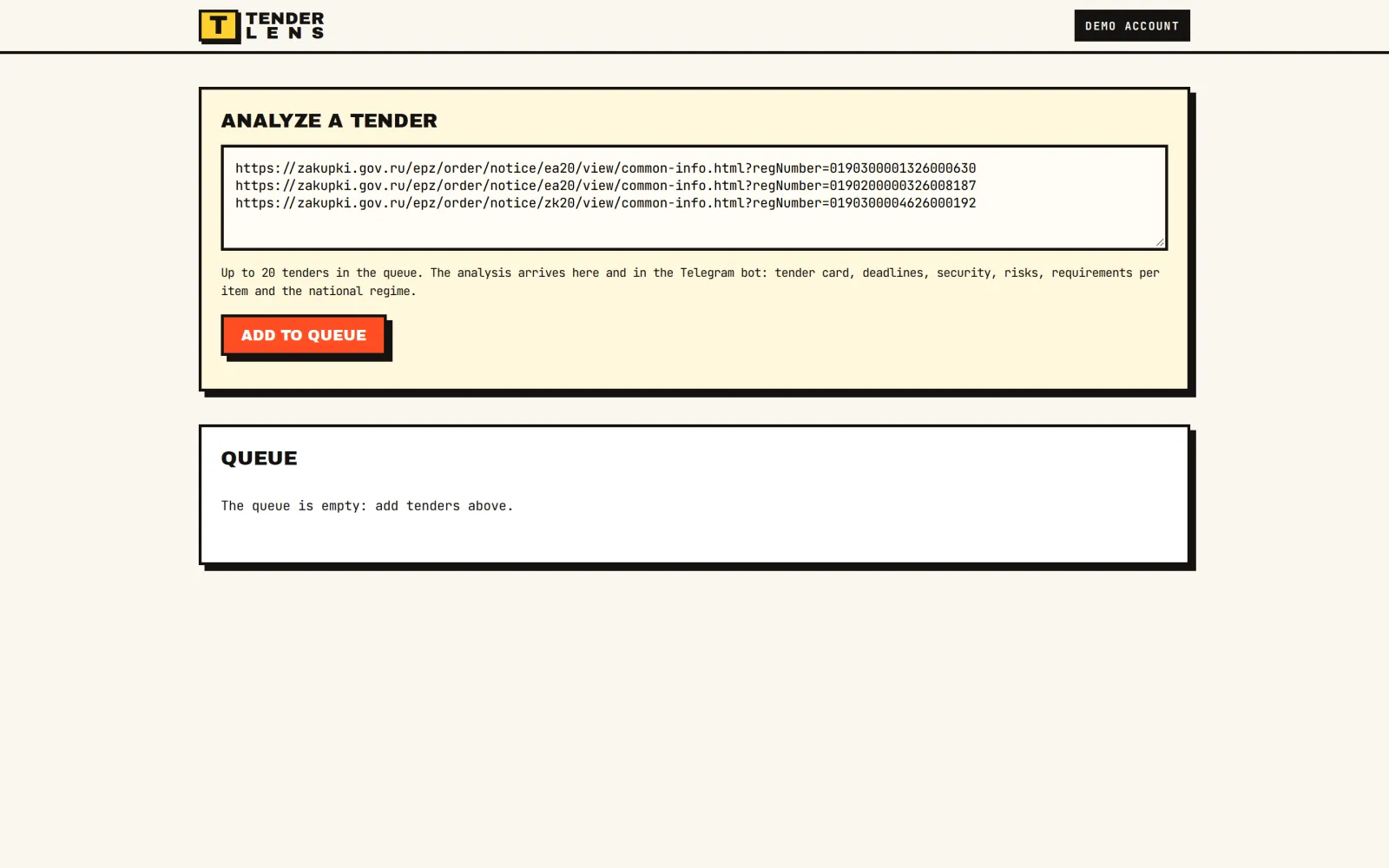
The dashboard has no password. You sign in with a one-time link in Telegram, so there is no password to set up or forget. The landing page and the dashboard joined the bot in July. The chat is handy for one tender on the phone, and the dashboard for a list of links at a desk.
What does an AI tool like this cost, and how do we start?
AI tools start from $500 and take from 2 weeks. TenderLens is the client’s own service; what we offer is a tool built the same way around your documents. The price depends on:
- what the AI has to read and what goes into the brief;
- how accurate it must be, and who checks it;
- which questions need fixed rules instead of the AI;
- where it lives: Telegram, a dashboard or both;
- how many documents a day it handles.
The first call and the written scope are free. We name the price once the work is agreed and counted, and it stays fixed unless the scope changes. You click through a working prototype before the bulk of the work, and the person who scopes the project builds it. Our article on how we scope a project walks through each step. We work remotely from Batumi, Georgia, in English or Russian.
A good first brief is narrow: one kind of document, a fixed set of fields, and a rule for every question a list can answer.
Questions
Can AI analyse tender documents under 44-FZ?
Yes. TenderLens, which we built for a client, takes a link from zakupki.gov.ru, reads every document and the notice page, and returns a brief with the tender card, risks, every item's requirements and the national regime.
What does an AI tender brief contain?
The tender card with the starting price, deadlines, payment and bid security; risks graded critical, warning or info; every item with its OKPD2 or KTRU code and requirements line by line; and the national regime for each item.
How long does an AI analysis of one tender take?
TenderLens prepares a brief in 2 to 3 minutes. An experienced specialist used to spend 10 to 20 minutes on the same tender.
Can I trust the figures in an AI tender brief?
In TenderLens the AI may not fill in values the documents don't give, guess market prices or name brands that are not in the text, and the same documents give the same brief every time. Next to each item the brief says in plain words what the item is, so a misread line shows before you bid.
Who decides the national regime in the brief?
Fixed rules, not the AI. Each item's OKPD2 or KTRU code is checked against the lists of Government Decree No. 1875: a ban, a restriction or a preference for domestic goods.
Does TenderLens work with tenders outside Russia?
No. It handles only Russian public procurement under 44-FZ and takes its links from zakupki.gov.ru. For other documents we can build a tool of the same kind around your own paperwork.
How much does an AI tool for tender analysis cost?
AI tools start from $500 and take from 2 weeks. The first call and the written scope are free, and the price is fixed before work starts.
Sources
- Russian Ministry of Finance: Consolidated analytical report on procurement monitoring for 2024 (published 29 May 2025)
- Russian Ministry of Finance: Letter of 31 January 2025 No. 24-01-06/8697 on applying Government Decree No. 1875 (national regime in procurement)
ZabSoft is a software company in Batumi. The person who scopes your project is the person who builds it.
More from the blog
 ZabSoft · Cases
A delivery bot and CRM in ten days
How a kitchen in Batumi moved lunch orders out of chat and into a Telegram bot and a dashboard, one day at a time.
15 Oct 2026 ZabSoft · Pricing
How much does a Telegram bot cost in 2026
What moves the price of a bot: the number of scenarios, payments, an admin panel, integrations and languages.
16 Oct 2026 ZabSoft · CRM
Build or buy: a CRM for a small business
When an off-the-shelf CRM is enough, and the signs that your process needs a tool of its own.
16 Oct 2026