Build or buy: a CRM for a small business
A ready CRM is often the right call. These are the signs your process has outgrown one, from a lunch kitchen’s order board to Pipey, our own light CRM.

On this page
Start with a ready CRM if your process fits its stock statuses and the team works in it every day. A tool of your own pays off when the process does not fit those statuses, or when the team keeps a spreadsheet next to the CRM. With us, a custom CRM costs from $500 and takes from 3 weeks.
When a ready CRM is enough
We build CRMs, and we still start with this: a ready CRM is often enough. If your sales follow the usual path from a new lead to a closed deal, and your team opens the CRM every morning without being reminded, there is little to gain from replacing it.
The useful question is whether your work fits the shape of the tool. A stock CRM comes with its own idea of what a deal is, which statuses it passes through and what each screen should show. If your process matches that idea, setting it up is most of the job. If it doesn’t, people start working around the tool.
Sooner or later the workarounds are the real system.
Two signs tell you a business has reached that point. The process does not fit the stock statuses, or the team keeps a spreadsheet next to the CRM.
What gets lost in spreadsheets and chats
Small studios and solo businesses sell in messengers. When we started Pipey, our own CRM, this was the setup we had in mind: a chat list, a notes app and a spreadsheet nobody updates, with a classic CRM looking like a project of its own.
That setup holds together on a slow day. On a busy one, a few things slip:
- Orders get typed twice. In the lunch kitchen we built for, orders came in through chat, and each one had to be retyped before anyone could cook or deliver it.
- A client’s history is spread across chats and files, so nobody sees their earlier requests and notes on one page.
- Today’s work has to be pieced together. To know what to cook and where to deliver it, someone scrolls back through the chats and checks them against the spreadsheet.
- A message has no status. Whether an order was accepted, cancelled or delivered lives in somebody’s head.
A ready CRM fixes much of this if your work fits it. The next question is whether it does.
Signs your process needs a tool of its own
Each row pairs a sign with what it looked like in one of our projects.
| Sign | What it looked like |
|---|---|
| Your statuses are not the stock ones | The lunch kitchen’s board has five columns, from new to delivered. Moves between them follow fixed rules, so an order cannot skip a step. |
| Some moves need a reason | Rejecting, cancelling or a failed delivery asks for a reason. |
| Your rules change once real orders arrive | After the first real weekly order, the rule changed: accepting one day accepts the whole week, and the client gets one confirmation. |
| Orders come from a bot or a site | Orders from the lunch bot land on the board on their own, with nothing to retype. |
| You plan on a calendar | The kitchen’s menu lives in a monthly calendar. Drag a day onto a taken date and the two menus swap, photos included. |
| Part of the work is not deals at all | The design studio runs its portfolio and blog from its own admin panel, without calling a developer: posts in a built-in editor, works in their own section with categories. |
The spreadsheet next to the CRM is the plainest sign of all. If the team keeps one, the CRM doesn’t hold what they need, and the real work happens somewhere else.
One row on its own, and a ready CRM may still bend to fit. Several, and a tool of your own is worth pricing.
What a board of your own gives you
A CRM built for one business is a short list of parts, each shaped around how the team already works:
- a board with your statuses, where a status cannot be skipped by accident;
- client cards with every client’s requests and notes on one page;
- a calendar for menus, shifts or bookings, if you need one, where you drag things around;
- today on one screen: requests, sets to cook and deliveries, without a spreadsheet;
- orders from a Telegram bot or a site form landing on the board on their own;
- an AI panel next to each conversation that drafts a reply and sums up the thread.
In the lunch project, the board, clients, statistics and broadcasts were ready on the second day, and weekly orders on the third. The whole system took ten days. Staff got their own role in the same bot, with today’s orders to pack and deliver.
Pipey shows the same idea for a business that sells in conversations rather than orders. Messages land in one inbox and are tied to a contact and a deal automatically. Deals sit on a visual pipeline: on a computer you drag them between stages, on a phone you swipe, and an undo button stays for a few seconds.
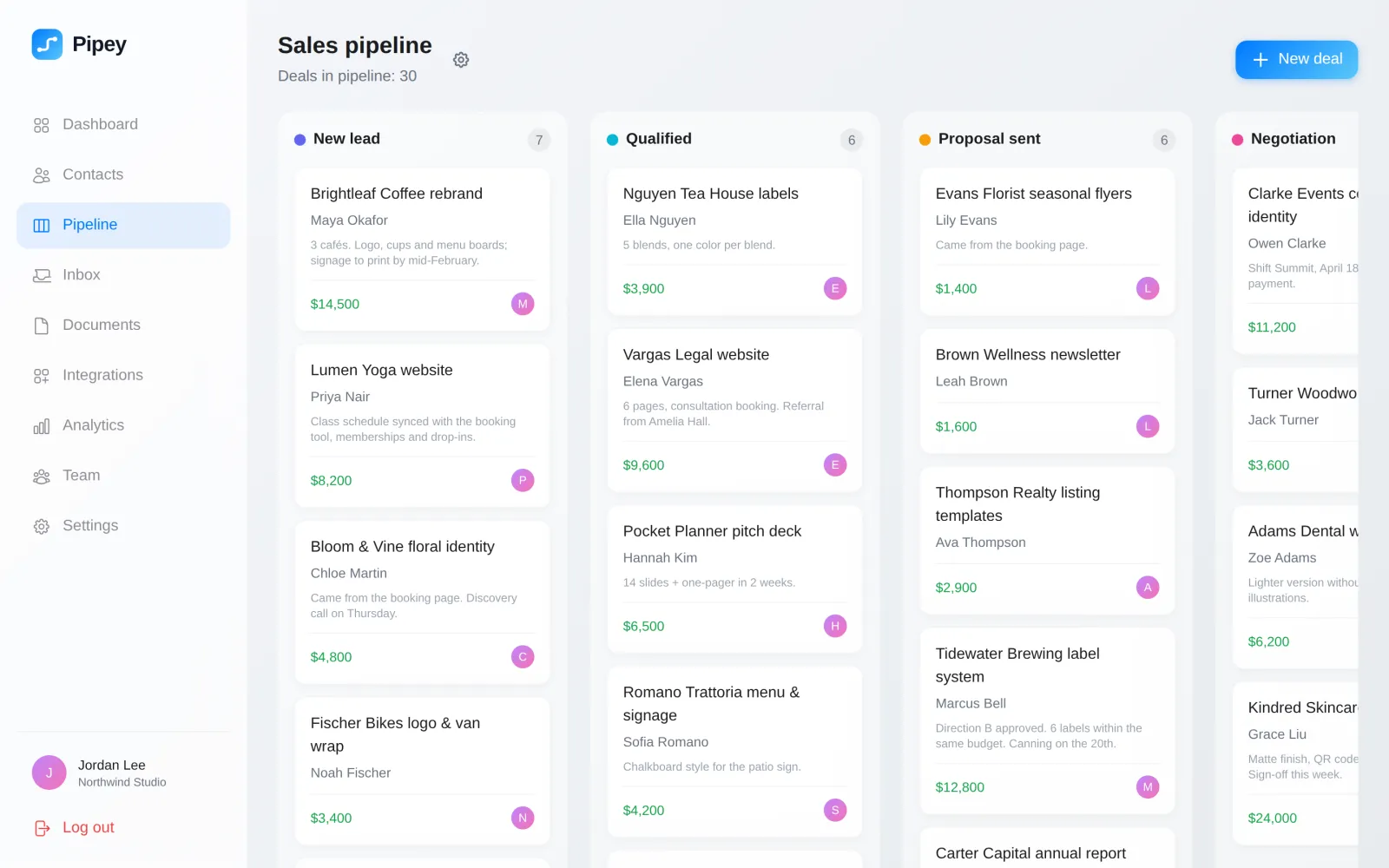
In Pipey, the AI panel from the list above also suggests the next action, and no draft goes out until you send it. From a deal you can make a quote or an invoice as a PDF, or send a link to a booking page where clients pick a slot in the next two weeks.
If you never wanted a CRM at all
We built Pipey as a lightweight CRM for people who never wanted one. The idea was value in ten minutes: connect a channel, see the conversations, take an action, reply. It starts from the conversation, because that is where a business selling in messengers already works.
That is a third answer to build or buy. If a full CRM looks like a project of its own, the tool you need may be a smaller one that starts in the chats rather than in a database of contacts.
Pipey is in our archive now, as a beta. We show it here as a picture of what a light CRM can look like. The demo runs the real interface in the browser, and a reload resets everything.
What your own CRM costs, and how fast
A CRM or internal tool with us costs from $500 and takes from 3 weeks. Above that, the price depends on a short list:
- how many roles and screens there are;
- how many statuses, and how many rules between them;
- integrations: a bot, a site, payments, messengers;
- moving data from your spreadsheet or current CRM;
- reports and statistics.
Most of that list describes your process. So it doubles as a build-or-buy test: the more statuses and rules your work really has, the harder it is to squeeze into stock ones.
The price is fixed before the work starts, in a written scope you get after the call. What happens after that, from the prototype to support, is in our article on how we scope a project.
Questions
Is an off-the-shelf CRM enough for a small business?
Often, yes. A tool of your own pays off when your process does not fit the stock statuses, or when the team keeps a spreadsheet next to the CRM.
How much does a custom CRM cost?
From $500. The price depends on the number of roles and screens, the statuses and rules between them, integrations, moving your data, and reports. After a call you get a written scope with a fixed price.
How long does it take?
From 3 weeks. You don’t wait until the end to see it: first you click through a working prototype, then every week we show you what is ready.
Can orders from our Telegram bot or site land in it?
Yes. Orders from a Telegram bot or a site form land on the board on their own. In the lunch project, the orders come from a Telegram bot.
Can I see a CRM like this before deciding?
Yes. The lunch kitchen’s dashboard runs as a live demo on fictional data, and the board and the calendar work in the browser. The Pipey demo runs its real interface in the browser too.
ZabSoft is a software company in Batumi. The person who scopes your project is the person who builds it.