Where AI saves time in a small business, and where it doesn’t
Four jobs AI already does in our projects, from tender briefs to reply drafts, and the places where we took it out or left the last word to a person.

On this page
AI saves time when it does one narrow job: reading documents into a brief, scoring leads, drafting replies, making pictures from photos. Each of these is in one of our projects. It costs time when its accuracy falls short or nobody checks what it produces. That is why we took two features out of a tender tool, and why in Pipey the AI drafts a reply and a person sends it.
Four jobs, four projects
Ask what AI can do for a small business and you usually hear one of two answers: a bot that sells for you while you sleep, or “it’s all hype”. We’ll stick to what we have built ourselves, for clients and as our own products. That is the only evidence we can vouch for.
Our AI work so far comes down to four jobs, each of them narrow:
| Job | Project | What the AI does | Where it runs |
|---|---|---|---|
| Documents | TenderLens | Reads tender documents and fills a fixed brief for each tender | A Telegram bot and a web dashboard |
| Leads | TGtrigger | Labels each match hot, warm, cold or spam and adds a one-line reason | A dashboard on your own server, with leads sent on to Telegram and your other tools |
| Replies | Pipey | Drafts a reply, sums up the thread and suggests the next action | A panel next to each chat in a CRM inbox |
| Pictures | CurtainBot | Turns a room photo and a fabric swatch into a picture of the finished curtains | Right in Telegram |
In TenderLens, TGtrigger and Pipey the AI reads, sorts or types, and a person makes the call.
The results land where the work already happens. TenderLens and CurtainBot work in Telegram, TGtrigger sends its leads to Telegram and to your other tools, and Pipey’s panel sits next to the conversation it is about.
CurtainBot is our own product, and it is live. It is built for curtain shops and interior designers.
Below, the other three jobs one by one, then the places where it fell short.
Reading documents: a brief instead of a tender pack
TenderLens is a client project, and one limit comes first: it works only with Russian public procurement, under the 44-FZ law. If you do not bid in Russian public tenders, it will not help you directly. It is still our clearest example of AI reading documents for a business.
Suppliers who bid in these tenders read the same pile for every lot: a long spec, contract terms, scanned attachments and the notice page, where the real item specifications often live instead of the documents. Reading all of it for every tender is slow work.
With TenderLens a supplier sends a link from zakupki.gov.ru and gets a brief back. The work is split like this:
- the bot collects every document, opens archives, reads scans and the notice page;
- the AI fills a brief with the same layout for every tender: a tender card with price, deadlines, payment and bid security, risks graded critical, warning or info, and every item with its codes and requirements line by line;
- the national regime (the bans, restrictions and preferences for domestic goods) is decided by fixed rules against the government lists, not by the AI.
Each brief arrives in the chat and in the web dashboard, where you sign in with a one-time link from Telegram instead of a password. The supplier reads one screen instead of the whole pack, and the facts on it come from the documents rather than the AI’s guesses.
That part took work. At one point the same tender gave one item 10 requirements on one run and 17 on the next. A brief that changes from run to run has to be checked against the documents every time, and then it saves nothing. So we set TenderLens up to give the same brief for the same documents. It is not allowed to invent values, market prices or brands, and filler requirements such as “as agreed” are stripped out.
Scoring leads: a short list instead of every chat
TGtrigger is one of our earlier products, now in the archive. Freelancers and small agencies find clients in public Telegram chats, where a real request sits between service ads, self-promotion and small talk. Reading dozens of chats by hand every day does not scale.
Here the AI is the last step, not the first. TGtrigger connects your Telegram accounts, listens to the chats you pick and waits for the phrases you set. Each match then passes your rules: the schedule, authors to ignore, words that rule a message out, and a check for repeats. The same author is muted for 24 hours, so one busy person cannot flood the feed. A plain list of phrases and a check for prices in the text then mark obvious service ads as spam, so the AI only sees messages worth a look.
Only then does the AI label what is left as hot, warm, cold or spam and add a one-line reason. Spam stays in the log and is never forwarded. Real leads go to people, bots or channels in Telegram and to your other tools.
You end up with a short list of messages that already passed your rules, each with an AI label and the reason behind it. The AI’s job ends at the label. Who to answer, and what to say, is up to a person.
TGtrigger ran until April 2026, and in June we made it open source. Its demo runs on fictional English chats and leads, with everything that would reach Telegram switched off.
Drafting replies: the AI writes, you send
Pipey, an earlier product of ours that is now open source, is a light CRM for people who sell in messengers. It starts from the conversation: every message lands in one inbox, already linked to a contact and a deal.
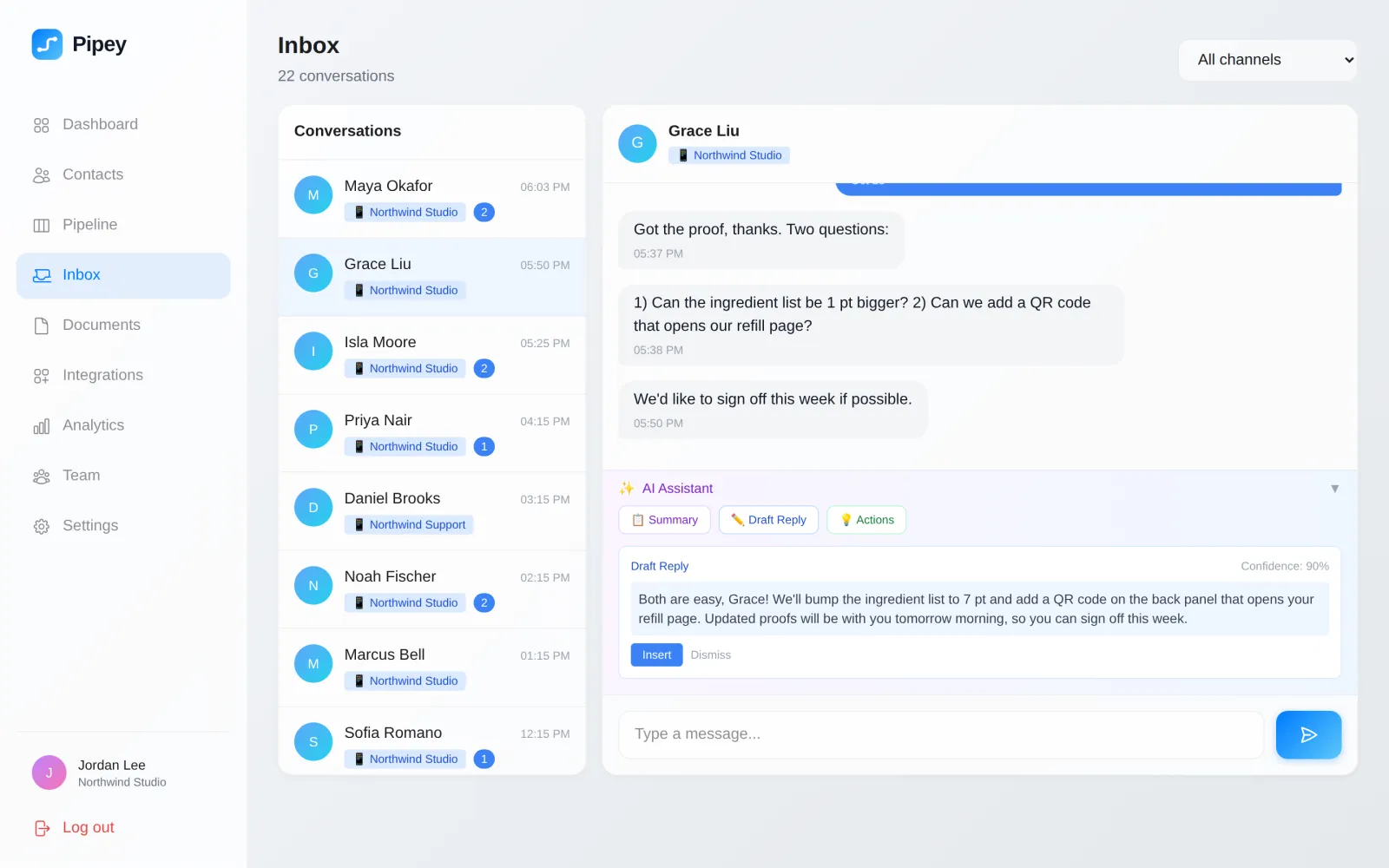
Next to each chat an AI panel drafts a reply, sums up the thread and suggests the next action. You edit the draft and send it. That human edit is the line between a drafting tool and selling on autopilot. The draft saves the typing and the summary saves rereading a long thread, and the person who knows the client still decides what goes out.
You can try this in Pipey’s demo: it runs the real interface on fictional data, and you can ask the AI panel for a draft.
Where AI does not save time
Here is where AI fell short in our projects, and what we changed.
TenderLens also had product search and margin calculation. Both were built, then taken out because their accuracy fell short. Better no answer than a wrong one: a margin figure you cannot trust has to be worked out again by hand.
Some questions don’t need AI at all. The client tested TenderLens on real tenders, and after a wrong national-regime conclusion was caught, that decision moved from the AI to fixed rules. TGtrigger comes at it from the other side: a plain list of phrases catches obvious ads before the AI sees them. If a list or a pattern can give the answer, a fixed rule gives the same answer every time.
Then there is output nobody checks, which is what selling on autopilot comes down to: a model sending replies, quotes and promises to your clients with no one reading them first. TenderLens, TGtrigger and Pipey all stop one step short of that.
What it takes to start
AI tools start from $500 and take from 2 weeks. What moves the price:
- what the AI has to read or produce;
- how accurate it must be, and who checks it;
- where it lives: Telegram, CRM or site;
- how many documents or messages a day;
- integrations with your data.
It runs like all our projects: a call, a written scope with a fixed price, a prototype you can try, then the build with weekly demos. Our article on how we scope a project covers each step.
A good first AI project is small and a little boring: one pile of documents, one set of chats, one kind of reply. Pick the reading or typing that eats the most hours and that a person can check at a glance.
Questions
What can AI do for a small business today?
Read documents, draft replies, score leads and make pictures from photos. Each of these is in one of our projects: TenderLens, Pipey, TGtrigger and CurtainBot.
Does the AI send replies to clients by itself?
Not in Pipey: the AI drafts a reply next to each chat, and a person edits it and sends it. TGtrigger labels leads and forwards them to Telegram and your other tools; who to answer, and what to say, is up to a person.
How much does an AI tool cost, and how long does it take?
It starts from $500 and takes from 2 weeks. The price depends on what the AI reads or produces, how accurate it must be and who checks it, where it lives, how many documents or messages it handles a day, and integrations with your data.
Can it work inside Telegram?
Yes. TenderLens and CurtainBot both work in Telegram, and TGtrigger sends its leads there.
Does TenderLens work with tenders outside Russia?
No. It works only with Russian public procurement under the 44-FZ law. We use it here as an example of AI reading documents.
ZabSoft is a software company in Batumi. The person who scopes your project is the person who builds it.