How much does a Telegram bot cost in 2026
A bot’s price follows what it has to do. Here are the five things that set it, with examples from two bots we built: one for a lunch kitchen in Batumi, one for an English teacher.

On this page
A bot starts from $100 and takes from 3 days to launch. The final price depends on five things: how many scenarios the bot handles, payments, where the admin panel lives, integrations and languages. You get it as a written scope with a fixed price after the first call, before the work starts.
The starting price and what moves it
Our Telegram bots start from $100 and take from 3 days to launch. What your bot ends up costing depends on what it has to do.
Five things move the price:
- how many scenarios the bot handles;
- payments;
- an admin panel, in the bot or on the web;
- integrations with your CRM, sheets or site;
- languages.
Hours are not on the list, and the price is fixed in a written scope before the work starts. Here are the five, one at a time, with examples from two bots we built. One takes lunch orders for a kitchen in Batumi. The other sells seats in small English classes for a teacher who runs nine groups of up to four students each.
Scenarios: everything the bot does
A scenario is one path through the bot, from the first tap to the result. Ordering lunch is a scenario. So is reminding a student who hasn’t paid, or closing a class once it is over. Each one has its own steps and rules, and each one adds to the work.
From the client’s side, the lunch bot looks simple: tap a day or the whole week in the menu post, then choose the number of sets, cutlery and an address. The rules sit behind the buttons. The owner sets a cutoff the day before each date, and at noon Batumi time every day the bot sends the menu for the day after tomorrow to everyone with a delivered order in the past week.
The English school bot has more paths, because a seat in a class is something people hold, buy, use up and lose. A student opens group classes and sees every group with its level, day, time and free seats. The seat is held for 15 minutes while they pay for one class or a package of four. After payment the bot sends a personal invite to the group’s private chat. New students can also send a voice message for a free level check, and the teacher replies with their level.
Then come the scenarios that start on a clock, not with a tap. Two hours after a class starts, the bot closes it, charges one lesson for each paid seat and asks the teacher whether the class took place. One tap keeps the lesson for a student with a good reason, and “the class didn’t happen” gives everyone their lesson back. A student with no lessons left gets 72 hours to pay for the next one, with reminders at 72, 48, 12 and 2 hours. If they don’t pay, the seat is released, they leave the group chat and the waiting list for that level hears about the free seat.
By hand, in chats, this routine is a second job. Every sentence in those two paragraphs is a scenario or a rule inside one, and the bot starts the ones on a clock by itself.
| Detail | Lunch delivery: bot and dashboard | English school: bot |
|---|---|---|
| What a client does | Picks a day or the whole week, the number of sets, cutlery and an address | Picks a group, pays for one class or a package of four, gets an invite to the group’s chat |
| Admin panel | A web dashboard with an order board and a menu calendar | Inside the same bot |
| Staff | Their own role in the bot, with today’s orders to pack and deliver | The teacher runs requests, groups and level checks from the bot |
| On a schedule | The menu for the day after tomorrow, every day at 12:00 | Each class closes two hours after it starts; payment reminders at 72, 48, 12 and 2 hours |
| Live | The bot on the first day, the whole system in 10 days | 5 days after work began |
Payments: the part that keeps count
A bot that takes payments does two jobs. It takes the payment, and it keeps track of what each customer has paid for. In the English school bot, that second job meant a lesson balance for every student.
Every change to that balance has a reason. A payment adds lessons, a class that took place charges one, and a class that didn’t happen gives it back. Absences, a move to another group and manual corrections go through the same balance, so it always matches the seats the student has paid for in the classes ahead.
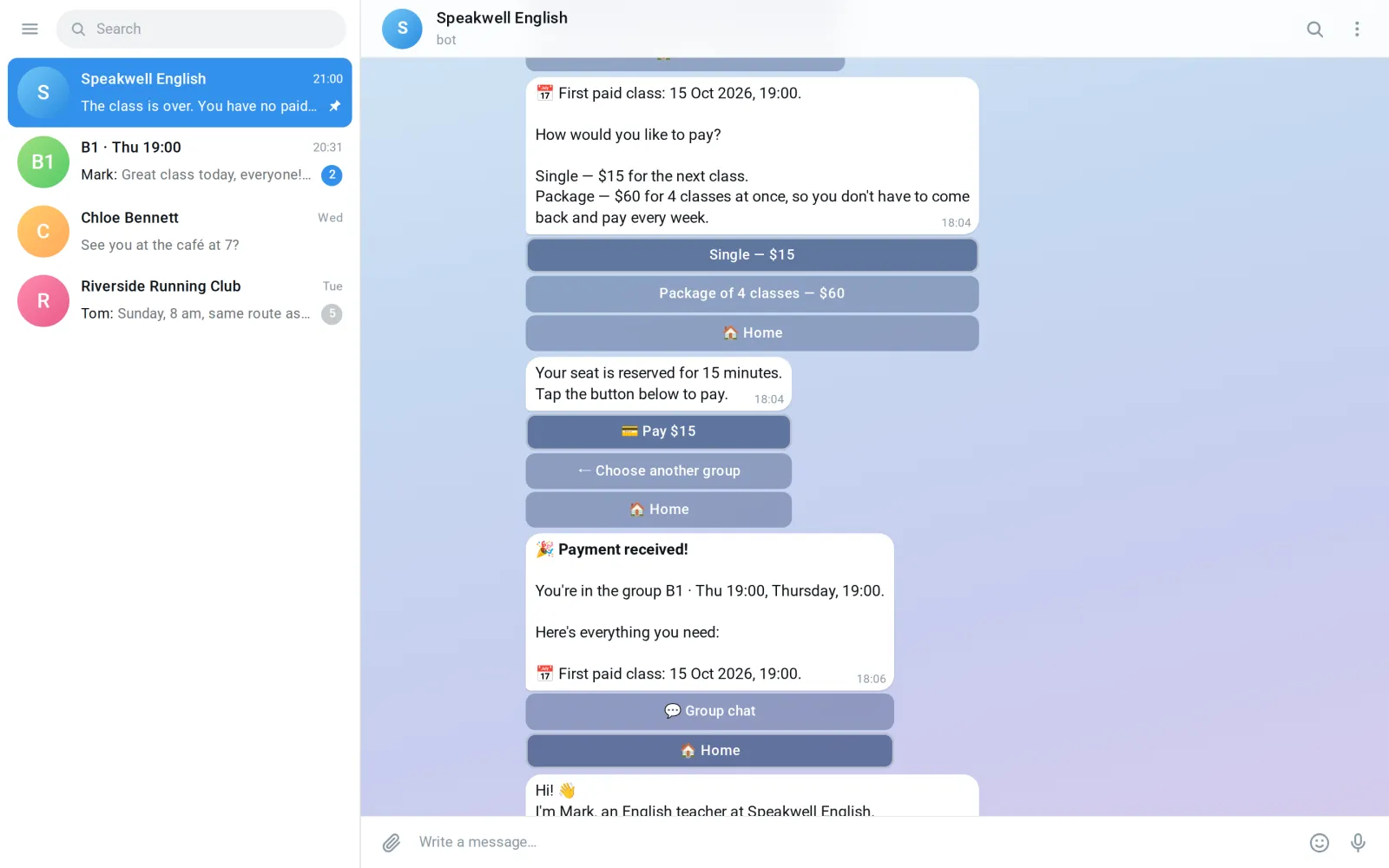
Payment rules also change while the bot takes shape. On 13 August, two days before launch, the school bot’s payment model changed. A shared weekly payment day gave one group four days between class and payment and another a few hours, so payment moved to a cycle around each class.
Every one of those rules goes into the scope, so a bot that collects orders and leaves the money to you is a smaller job than one that sells seats, charges lessons, gives them back and frees the seats nobody paid for.
The admin panel, integrations and languages
Someone has to run the bot every day: change the menu, see the orders, answer a request. That happens in an admin panel, and it can live in one of two places.
The English school bot keeps it inside the same bot the students use. The teacher’s panel there covers requests, groups, level checks, statistics, promo codes and texts.
The lunch kitchen’s owner works in a web dashboard instead: an order board with five columns from new to delivered, and a monthly calendar where the menu for any day can be dragged to another date.
A web dashboard is a second interface next to the bot, and the choice between the two is on the list of price drivers. Either way, your staff can work in the bot too. Couriers, managers and teachers see only what they need: today’s orders, their groups, their tasks.
Integrations come fourth: your CRM, your sheets, your site. In the lunch project, orders from the Telegram bot land on the board on their own, so nobody has to retype them, which is what taking orders in chat used to mean. Each system the bot exchanges data with is one more connection in the scope.
Languages come fifth: every message and button a customer sees has to exist in each language the bot speaks.
What costs least at the start
Because the price follows the work, the cheapest way to start is the smallest bot that does the core job. The rest can come after launch, once you see how people use it.
Both bots in this article went live early and kept changing after launch. The lunch bot went live on 3 October 2026, the first day of the project. The order board came the next day and weekly orders the day after, and once the first real weekly order arrived, the way the kitchen accepts those orders changed too.
The English school bot went from its design on 10 August 2026 to launch on 15 August. Students could join several groups from 23 August, after the bot was already live.
So a first version can be one scenario, the one you now handle by hand in chats, in one language, with a clear answer on where the admin panel lives. Integrations can wait until some data would otherwise be retyped.
Why the price is fixed after the first call
Before the first call, nobody knows how many scenarios your bot needs, whether it takes payments, where the admin panel lives, what it connects to or how many languages it speaks. Those five answers set the price. After the call they are written down, and so is the number.
It starts with a short call about your business, and the written scope follows it. Then you try a clickable version before we build the rest, and you see weekly demos while we do. The article on how we scope a project, linked below, walks through each step.
Questions
What is the starting price of a Telegram bot?
It starts from $100 and goes up with the work. The final price depends on the scenarios, payments, the admin panel, integrations and languages, and it is fixed in a written scope after the first call.
How long does a bot take?
From 3 days. The English school bot, with payments, lesson balances and the teacher’s admin panel, went live five days after work began.
Do I pay by the hour?
No. The price moves with the work, not with the hours, and it is fixed before the work starts.
Can the bot take payments?
Yes, and payments are one of the five things that set the price, because the bot has to keep count as well as take the money. In the English school bot that means a lesson balance for every student.
Who looks after the bot after launch?
The same person who built it. We stay on for fixes and changes after launch.
ZabSoft is a software company in Batumi. The person who scopes your project is the person who builds it.