AI chatbot for a website: what it can do and what it costs
What an AI chat on a small business site can take off your hands, where it has to stop and call a person, how to keep it to your own prices, and what sets the price.

 AI · Chatbot for a website
On this page
An AI chatbot for a website answers visitors in plain language at any hour, from your own prices, services and rules, collects the request and hands the conversation to a person when the question goes beyond what it was given. Left to answer from general knowledge, it will make up prices and promises, and the business answers for them: in 2024 a Canadian tribunal held Air Canada responsible for wrong fare advice from the chatbot on its website. We build AI tools from $500, from 2 weeks, and the price grows with channels, languages, connections to your CRM and documents the bot has to read.
In numbers- AI tools start from $500 and take from 2 weeks; the price is fixed in a written scope before work starts.
- In February 2024 a tribunal in British Columbia held Air Canada responsible for wrong fare advice from its website chatbot and rejected the idea that the chatbot answered for itself.
- Intercom’s ready AI agent costs $0.99 per outcome, roughly each conversation it resolves, on top of helpdesk seats from $19 a month billed yearly (October 2026).
- CurtainBot, our own AI product, checks the room and fabric photos before it starts and says which photo to send instead of drawing a bad picture.
- In TenderLens, our AI document tool, a value the documents don’t give stays “not stated” instead of being guessed.
What does an AI chatbot on a website do?
It answers the questions visitors would otherwise send you or leave unasked: what a service costs, whether you have a free day next week, how delivery works, what to bring. It answers in plain language, at any hour and in the language the visitor writes in, and it answers from what you gave it: your prices, your services, your rules.
Button bots worked differently. A button bot walks a visitor through a menu you wrote in advance and stops at the first question that isn’t on it. An AI chatbot reads the question as it was typed and finds the answer in your material, so “do you do brows on Saturdays and how much” gets a real reply.
Then comes the part that earns its keep. A good chatbot asks what a manager would ask, takes a name and a contact, and passes the request with the whole conversation to you, in Telegram or in your CRM. For a property developer that means budget, purpose and a booked viewing, and our article on an AI sales manager for developers goes through it step by step.
What it can’t do, and why that matters
It can’t be trusted with anything it wasn’t given. A language model writes fluent answers whether or not it knows the facts, so a chatbot left to answer from general knowledge will invent a discount, a delivery date or a refund rule, and say it with confidence.
The business answers for that. In 2022 a passenger asked the chatbot on Air Canada’s website about bereavement fares, booked on its advice and was later refused the refund it had described. Air Canada argued it could not be held liable for what the chatbot said. In February 2024 the Civil Resolution Tribunal of British Columbia called that a “remarkable submission”, found that a chatbot is just part of the company’s website, and ordered the airline to pay the difference.
The second failure is a loop with no way out. The US Consumer Financial Protection Bureau looked at chatbots in banking in its 2023 report and described “doom loops”: the customer’s question falls outside what the bot can do, and it keeps sending them back to the same links and answers, while reaching a person can mean a long wait.
So keep it on the first line: common questions, prices from your list, collecting the request. Discounts, exceptions, complaints and anything that commits you to money stay with a person.
How do you keep it to your prices and rules?
You give it your material and forbid everything else. We load your price list, services, hours, delivery and refund rules and the answers you already give on the phone, and the chatbot may quote only what is in them. When a question goes beyond that, it says a person will answer and passes it on. A made-up price in a chat is worse than no answer: the visitor remembers it, and you have to take it back.
We learned this rule on TenderLens, an AI tool that reads tender documents. Early on, the client caught a brief that turned a 5% bid security into “5 to 30%”. Since then the AI there may not fill in values the documents don’t give, and a value they don’t state stays “not stated”.
All of this depends on one thing on your side. The material has to be current. If a price changed this morning, the list the chatbot reads has to change too, whether that list is a spreadsheet you already keep or your CRM. Where it lives and who updates it is one of the first things we settle in the scope.
When should it hand over to a person?
Whenever the conversation needs a decision the chatbot can’t make. There are three moments to plan for:
- the visitor asks for a person;
- the visitor is unhappy, or writes about a complaint, a refund or a mistake;
- the answer isn’t in the bot’s material, such as an exact price for a custom job.
The person who takes over gets the whole conversation and a short summary, so nobody asks the visitor to start again. The request lands where you already work: a Telegram chat with your team, or a card in your CRM.
Some businesses want an even shorter leash, and that works too. In Pipey, our beta CRM for people who sell in messengers, now in our archive, the AI drafts a reply next to each chat and a person edits it and presses send. The AI saves the typing, and the person who knows the client decides what goes out.
| Situation | AI chatbot | Your team |
|---|---|---|
| A common question | Answers at once, from your material | Keeps the material up to date |
| A price or a free date | Quotes it from your current list | Confirms anything the list doesn’t give |
| A request | Asks the questions, takes a name and a contact | Gets it with the whole conversation |
| “Can I talk to a person?” | Hands over straight away | Picks up the conversation |
| A complaint, a refund, a discount | Never decides | Decides |
What our own AI product taught us
CurtainBot is our own product for curtain shops and interior designers. It isn’t a chat consultant: it does one narrow AI job. A client sends a photo of a room and a photo of a fabric swatch, picks a curtain style, and gets back a picture of that room with curtains in that fabric. It works on its site and in Telegram.
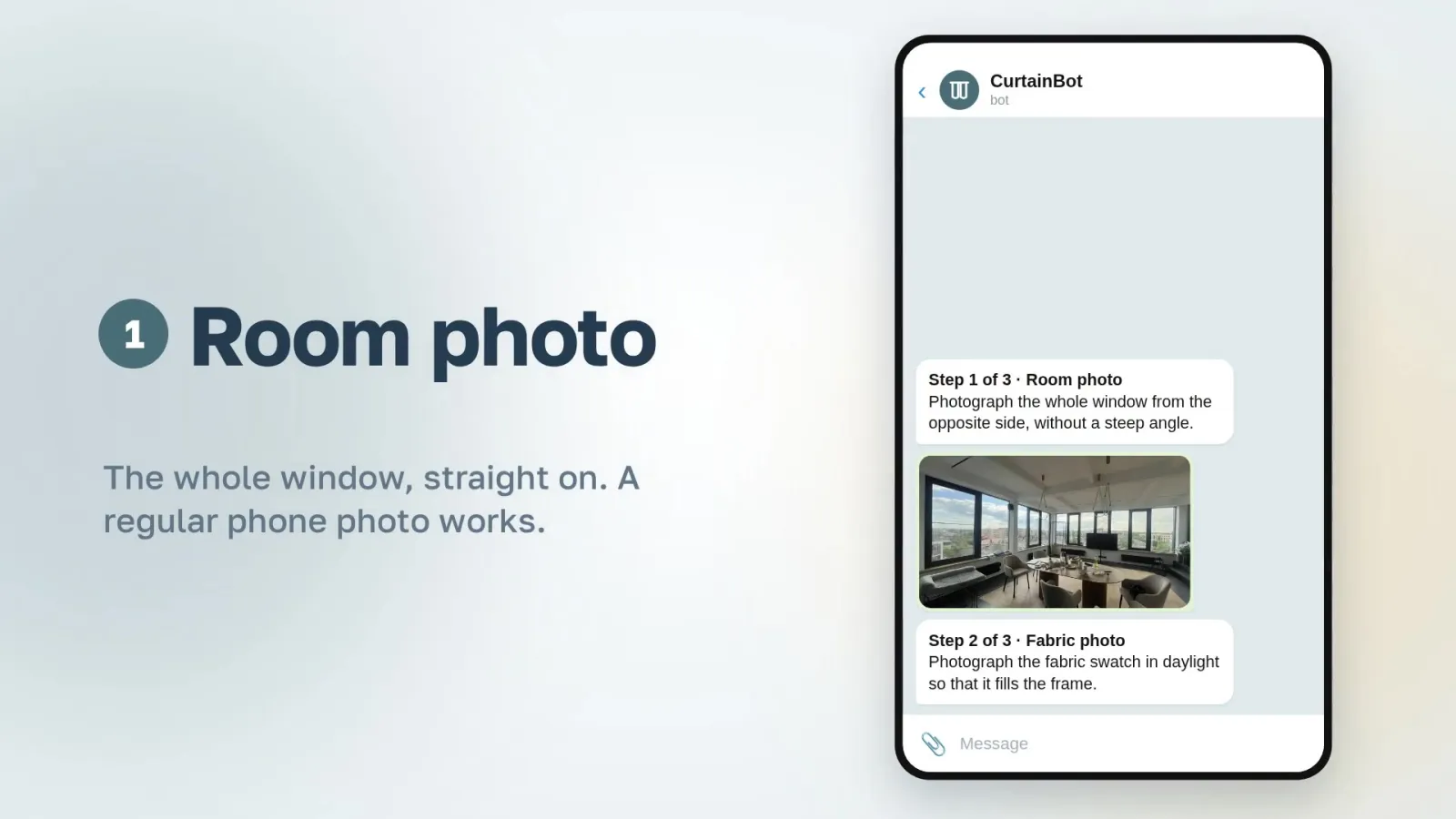
The rules that keep it honest are the ones a website chatbot needs. Before it draws anything, it looks at both photos. If there is no window, the photo isn’t of a room, it can’t be made out or the fabric photo shows no fabric, it doesn’t try: it tells the client which photo to send, and the attempt is given back. That is the image version of “a person will confirm” instead of a made-up answer.
After drawing, the result goes through a quality check, and a preview that fails it is never charged. If attempts keep failing for the same client, the bot pauses, tells them someone will get in touch and calls in our team with the reasons. A run of failures ends with a person, not with one more bad picture.
What does an AI chatbot cost?
Our AI tools start from $500 and take from 2 weeks. On our AI tools page, the typical “AI consultant that collects requests” is from $750, counted from our price list: it answers clients on your site and in Telegram in two languages and passes you the requests. What moves the price:
- channels: each one beyond the first, such as Telegram or WhatsApp next to your site, adds $150;
- connections: each link to your CRM or another service adds $200;
- documents: if the chatbot has to read PDFs, scans or archives, $300;
- languages: each extra language adds $100.
On top of the build there are two running costs, and you pay both. The language model is paid for by usage: the more conversations a day, the more it costs. The other is hosting, which is included in the support price if the chatbot is on our support.
Pick what your chatbot needs and see a rough price. It counts from our price list, so it is a starting point for the call, not a quote.
A rough estimate, not a quote. The exact price comes in the written scope after a free call: some things turn out simpler than they look, some harder.
Get an exact price →- One AI task in one channel: Telegram, your site or your CRMfrom $500
- Each extra channel+$150
- Each connection to your CRM or a service+$200
- Reading documents: PDF, scans, archives+$300
- Each extra language+$100
A ready chatbot service or one built for you?
A ready service is quicker to try. Intercom, for example, listed its Fin AI Agent at $0.99 per outcome on its pricing page in October 2026. An outcome is roughly a conversation the agent resolves or completes, there is a monthly minimum, and helpdesk seats start from $19 a month per seat billed yearly. If you already work in such a helpdesk, it is a reasonable start.
A chatbot built for you costs more up front and fits your setup instead of the other way round. It answers in your Telegram, your WhatsApp or your site, writes to your CRM and follows your rules on what it may quote and when it calls a person. You pay for the build once, at a price fixed in the scope, plus the model’s usage and hosting, with hosting included if we support the chatbot.
A simple test: if your questions are standard and you are happy to work in someone else’s inbox, try a ready service. If the chatbot has to know your price list line by line, talk in the channels your clients already use or feed a CRM you rely on, a custom one is the better fit.
How do you start?
Small: one channel, one language and the questions you answer every day. That is enough to see what visitors really ask, how many requests come in and where your price list needs work, before you add a second channel. If what visitors want most is to book a time, a booking bot with buttons may be all you need, and it costs less.
It runs like our other projects. After a free call you get a written scope with a fixed price, which changes only if the scope does. You try a working prototype on your own material before the bulk of the work starts. The person who scopes the chatbot builds it and stays on after launch. Our article on where AI saves time in a small business shows the same approach in our other AI projects.
Questions
What can an AI chatbot on a website do?
Answer common questions in plain language at any hour, from your own prices, services and rules, ask what a manager would ask, take a name and a contact, and pass the request with the whole conversation to you in Telegram or your CRM.
How much does an AI chatbot for a website cost?
Our AI tools start from $500 and take from 2 weeks. Each extra channel such as Telegram or WhatsApp, each extra language and each connection to your CRM adds to it, and the price is fixed in a written scope after a free call. Running costs are yours: the language model is paid for by usage, and hosting comes on top, unless the chatbot is on our support, which includes it.
Will an AI chatbot make up answers?
It will if it is allowed to answer from general knowledge. We limit it to your data: it quotes only your price list and rules, and a question beyond them goes to a person. In 2024 a Canadian tribunal held Air Canada responsible for wrong advice from the chatbot on its website.
Can the chatbot hand a conversation over to a person?
Yes, and it should: when the visitor asks for a person, when they are unhappy, and when the question goes beyond what the bot was given. You get the request with the whole conversation, so nobody asks the visitor to start again.
Is a ready AI chatbot service cheaper?
To start, often yes. Intercom, for example, charges $0.99 per outcome for its AI agent, roughly each conversation it resolves, plus helpdesk seats from $19 a month billed yearly, as of October 2026. A chatbot built for you costs more up front, from $500, and follows your own rules, channels and CRM.
Can it answer in Telegram and WhatsApp as well as on the site?
Yes. Each channel uses the same knowledge and rules. WhatsApp first needs Meta to check your business, which takes time on their side.
Have you built an AI chat consultant before?
There is none among our published cases yet, so we don’t quote results for one. We have built its parts: TenderLens answers only from the documents, Pipey drafts replies that a person sends, and CurtainBot, our own product, checks what it is given before it answers.
Sources
- Civil Resolution Tribunal of British Columbia: Moffatt v. Air Canada, 2024 BCCRT 149, decision of 14 February 2024 (PDF)
- Consumer Financial Protection Bureau: Chatbots in consumer finance, 6 June 2023
- Intercom: pricing of the helpdesk and the Fin AI Agent (opened 31 October 2026)
ZabSoft is a software company in Batumi. The person who scopes your project is the person who builds it.
More from the blog
 ZabSoft · Bots
Telegram booking bot: how clients book, pay and get reminders
Free slots, a slot held while the client pays, reminders, cancellations and your staff’s day: how a booking bot works and what it costs.
31 Oct 2026 ZabSoft · Cases
A delivery bot and CRM in ten days
How a kitchen in Batumi moved lunch orders out of chat and into a Telegram bot and a dashboard, one day at a time.
15 Oct 2026 ZabSoft · Pricing
How much does a Telegram bot cost in 2026
What moves the price of a bot: the number of scenarios, payments, an admin panel, integrations and languages.
16 Oct 2026